Designing an AI platform for collections
Role: Sr. UX Design & Research Manager
Timeline: In Progress
Team: Me and one designer/researcher, partnering with Product and Engineering
The challenge
Finvi has four core products, and some of them are very old. Collections agencies are under the same pressure as everyone else to start using AI, but rebuilding every application to add it isn't realistic.
We saw a different path: AI can act as a bridge between the product you have and the product you want. Instead of adding AI to each application, we're building one AI platform that agencies can use no matter which Finvi product they run on.
Finding the right place to start
Before designing anything, we needed to know where AI would actually help. We ran 13 one-on-one interviews with clients built around three questions:
- What are you using AI for today?
- What do you wish you could use it for?
- What do you not want AI doing?
The interviews pointed to call summaries as the clearest first step. They also showed us an opening competitors had missed. Existing call-summary tools lock the output: if an agency wants its notes written differently, it has to go back to the vendor and wait. So we allow the agencies to edit the prompts so they make edits fast. Finvi applications also already hold the account and call data so we can integrate better than anyone else. Providing more info to the AI, and making it so the agent sees the summary directly in the collections app.
I used AI to create a call notes summary POC. It is connected to twilio and an LLM. It listens to the call, transcribes it and outputs a summary. We used that POC to get feedback on the output, and to show clients that they could change the output themselves.
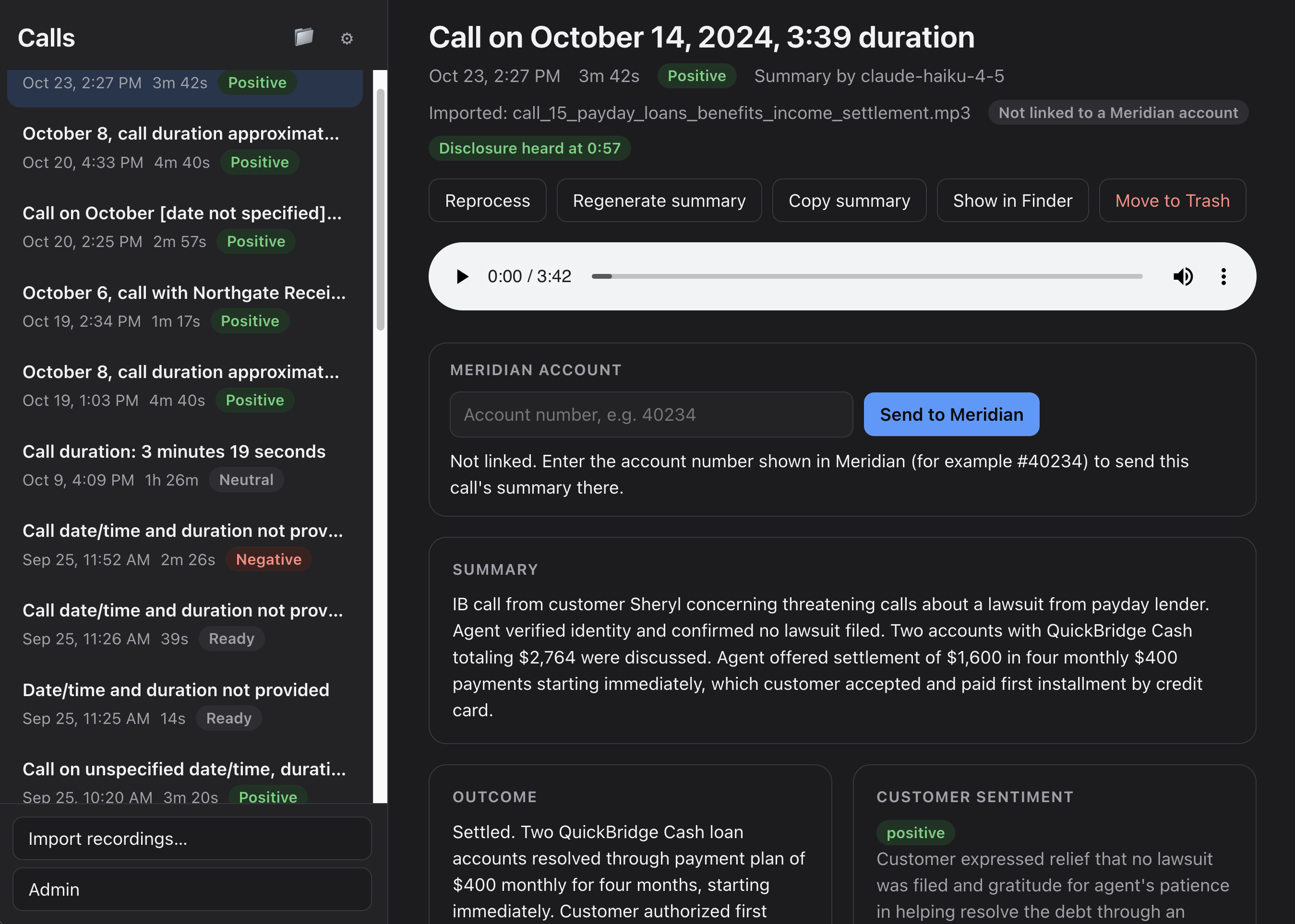
Designing for the platform, not the feature
We know call summaries are a starting point, not the vision. The goal is for the AI platform to become the place agencies work. That meant designing a structure that could support:
- Many AI features, not just one
- Many users and roles within an agency
- Every core application, old and new
- Purpose-built AI agents so different accounts can get the attention they need.
The allows Finvi to create an ecosystem of AI Products, reducing the number of vendors clients need, and strengthening the feature set of the applications.
An AI-assisted design system
The design system is where AI first made a dramatic difference in how I work. Engineering and I chose React and Radix as the foundation. I then used AI to build an editable design system on top of it that generates the React components developers use.
When I change a color, spacing value or almost any other design token in the editor, the change carries straight through to the the generated code. Dev decides when to use it, and they control the actual components. We are still working on the workflow.
Where it stands
The platform is still in development, built by a two-person design team.
What I'm most proud of so far is the foundation: research that found a real gap in the market, a platform structure that can grow well beyond its first feature, and a design system that lets a small team move at the pace of engineering.